
What Is BPC-157? The Body Protection Compound Explained
BPC-157 is a synthetic peptide made up of 15 amino acids, a sequence derived from a larger protective protein that occurs naturally in human gastric juice. The name says it plainly: Body Protection Compound 157. It is the lab-made, stable fragment of that gastric protein, isolated and reproduced so it can be studied on its own. In research circles it has picked up the nickname "the Wolverine peptide" because of how much of the work around it focuses on tissue repair and recovery.
Crucially, BPC-157 is not a hormone and not a growth factor. It is a short peptide that appears, in research models, to influence the local environment in which tissue repairs itself. Because the parent protein is found in the gut, much of the early interest sat with gastrointestinal research, but the work has since broadened to tendon, ligament, muscle and connective-tissue models. It is supplied here strictly for laboratory and educational research and is not approved for human consumption.
Important: BPC-157 is an investigational research compound. Nothing on this page is medical advice or a treatment claim. It is supplied strictly for laboratory and educational use, and is not approved for human consumption.
One reason BPC-157 became a focal point for the bpc-157 peptide research community is its reported stability. Many peptides are fragile, but the BPC-157 sequence has been described in research as comparatively robust, which is part of why it became such a workhorse molecule in preclinical recovery studies.
What BPC-157 Is Researched For: Tendon, Ligament, Muscle and Gut Models
The headline draw of BPC-157 is recovery research. Across a large body of preclinical work, body protection compound 157 has been investigated for its effects on the repair of soft and connective tissue. It is important to frame this honestly: these are research findings in animal and cell models, not proven human outcomes. With that hedge firmly in place, the bpc-157 research uses most often studied include the following.
Areas BPC-157 has been studied for in research models
- Tendon repair research, including how tendon cells migrate, proliferate and re-form after injury (the core of bpc 157 tendon repair research)
- Ligament and connective-tissue models, where the focus is on the speed and quality of repair
- Skeletal muscle injury and recovery models
- Gut and gastrointestinal research (bpc-157 gut research), reflecting its origin in gastric juice, including studies on the intestinal lining and gut integrity
- Bone and joint research, including cartilage-related models
- Nerve and vascular models, where its effect on new blood-vessel formation is studied
The through-line across all of these is repair and the formation of new tissue. That is what makes BPC-157 the anchor of NovaPeptides' recovery-focused kits. It is not framed as a substance that does one narrow thing; in the literature it is studied as a broadly "cytoprotective" peptide, meaning research looks at how it may support cells under stress. Again, these are research-model observations, not promises of any human result.
In the research literature, BPC-157 is less a single-target drug and more a peptide studied for how tissue rebuilds itself.
How BPC-157 Works in Research: Angiogenesis, Collagen and Nitric Oxide Pathways
Tissue cannot repair without a blood supply, and this is where much of the bpc-157 angiogenesis collagen research is centred. Angiogenesis is the formation of new blood vessels. In research models, BPC-157 has been studied for its apparent ability to promote angiogenesis, which would, in theory, help carry oxygen and nutrients into a healing site. A frequently cited mechanism in the literature is the upregulation of vascular endothelial growth factor (VEGF) signalling, one of the body's master switches for building new vessels.
The second pillar is collagen and the cells that produce it. Collagen is the structural protein that gives tendons, ligaments and skin their strength. Research has examined how BPC-157 may influence fibroblast activity and collagen organisation during repair, which is directly relevant to why it is studied in tendon and ligament models.
The third recurring theme is the nitric oxide (NO) pathway. Nitric oxide regulates blood-vessel tone and blood flow, and a substantial part of the bpc-157 healing research proposes that BPC-157 interacts with the NO system. Researchers have also looked at growth-factor receptor signalling, including pathways linked to FAK and other repair cascades. The honest summary: there are several plausible, partially evidenced mechanisms, and the full picture is still being worked out.
The working research model in plain English: support the blood supply (angiogenesis and the nitric oxide pathway), then support the structure (collagen and fibroblast activity). That two-part story is the working model researchers use to explain BPC-157, not a confirmed account of effects in humans.
BPC-157 in Australia: Legal Status, TGA Scheduling and Research-Use Framing
A common question is simply: is bpc-157 legal in australia? Here is the careful, accurate framing. BPC-157 is not registered as an approved therapeutic product you can buy over the counter, and it is a scheduled substance in Australia: it is captured under Schedule 4 of the Poisons Standard, meaning it is regulated as a prescription-only medicine. It is not a general consumer product, and it is not for human consumption outside a regulated clinical context.
What that means in practice for the bpc-157 legal australia question: NovaPeptides supplies BPC-157 strictly for laboratory and educational research, framed in line with its scheduled status. It is not offered as a treatment, it is not for human consumption, and it carries no therapeutic claims. Any clinical question should go to a qualified healthcare professional rather than being answered with medical guidance here.
There is also a sport-integrity point worth stating plainly. BPC-157 is on the World Anti-Doping Agency (WADA) Prohibited List, classified under S0 (non-approved substances) and banned both in and out of competition. For any athlete or researcher in Australia, that prohibited status is a relevant factual consideration alongside its regulatory status.
Bottom line on legality: in Australia BPC-157 is a Schedule 4 prescription-only substance under the Poisons Standard, not an over-the-counter product, and it is prohibited in sport under the WADA S0 category. It is handled here strictly as a research-use-only compound. Regulatory status can change, so the responsibility to confirm current rules sits with the researcher.
If you are searching for bpc-157 buy australia or bpc 157 buy australia, the most important filter is not price, it is provenance: who made it, and can the identity and purity be independently verified. That leads directly into the quality section below.
The State of the Evidence: Preclinical Strength and Human-Trial Limits
Intellectual honesty matters more here than anywhere else on the page. The evidence base for BPC-157 is genuinely interesting, but it is overwhelmingly preclinical. The large majority of supportive findings come from animal studies and cell-culture work, much of it from a relatively concentrated set of research groups. That is a real strength in volume and consistency, and a real limitation in scope.
Robust, large-scale human clinical trials are limited. This is the single most important caveat in any bpc-157 healing research discussion: results that look striking in a rodent tendon model do not automatically translate to humans, and the absence of large randomised human trials means efficacy in people has not been established. Anyone telling you BPC-157 is proven to heal a human injury is overstating what the science currently supports.
So the fair reading is twofold. First, the preclinical signal across tissue-repair, angiogenesis and gut models is consistent enough to explain why researchers keep returning to this peptide. Second, that signal has not yet been confirmed by the kind of human evidence that would make it a medicine. Both things are true at once, and a trustworthy guide says so plainly.
On bpc-157 side effects research: because controlled human safety data is limited, the human safety profile is not well characterised. Preclinical work has often reported favourable tolerability in the models studied, but that is not the same as established human safety. The lack of long-term human safety data is itself a key part of the honest picture.
Identifying Research-Grade BPC-157: Purity, HPLC and Janoshik COA
With a research peptide, identity and purity are everything. If you cannot verify that the powder in the vial is actually BPC-157, and actually pure, then any research built on it is meaningless. This is why research grade bpc-157 australia is defined by paperwork, not marketing. The gold standard is a third-party Certificate of Analysis (COA) that reports content and purity, typically using high-performance liquid chromatography (HPLC) for purity and mass spectrometry for identity.
Every NovaPeptides batch, including the BPC-157 inside the Wolverine Stack, GLOW and KLOW, is independently tested by Janoshik, a widely used independent peptide-analysis lab, and ships with a verifiable Certificate of Analysis you can request and read. No smoke, no mirrors: the COA reports the measured content and purity for that specific batch.
What a meaningful BPC-157 COA should show
- Independent third-party lab (such as Janoshik), not an in-house claim
- HPLC purity result for the actual batch you are receiving
- Mass-spectrometry identity confirmation that the peptide is the BPC-157 sequence
- Measured peptide content in milligrams, matching what is stated on the vial
- A test reference or batch number you can tie back to your specific product
Quality filter: if a supplier cannot hand you a batch-specific, third-party COA, treat the purity claim as unverified. For BPC-157, an unverifiable vial is not research grade, no matter what the label says.
Handling, Storage and Reconstitution for Research (General, Not Advice)
BPC-157 is supplied as a lyophilised (freeze-dried) powder, which is the stable form for transport and storage. In general research practice, lyophilised peptide is kept cool and dry, protected from light, and only reconstituted when it is going to be used. These are general handling notes for laboratory context, not instructions for use in humans.
General research handling principles
- Store the sealed, freeze-dried vial cold and dark until it is needed; the dry powder is the most stable form
- Reconstitute with an appropriate sterile diluent, commonly bacteriostatic water in research settings
- Add the diluent gently down the side of the vial rather than spraying directly onto the powder, and let it dissolve without aggressive shaking
- Once reconstituted, the solution is more fragile than the powder and is typically refrigerated and used within a limited window
- Label everything with the batch and reconstitution date so it ties back to the COA
Reconstitution is also where the arithmetic of concentration comes in: how much diluent you add determines how much peptide ends up in each unit of solution. That maths is exactly what the interactive pen guide is built to handle, so you are working from a calculation rather than a guess.
Dosing in Research: Why the Target Is a Qualified Professional's Call
This guide will not invent a bpc-157 dosage guide, and you should be sceptical of any page that does. The honest position is that a specific target is a decision for a qualified professional, not something to be read off a generic blog. What a good resource can do is give you the tools to translate a target into the correct measurement, accurately and without guesswork.
That is the entire purpose of the NovaPeptides interactive pen and dosing guide. You enter how much peptide is in the vial and how much diluent you reconstituted it with, and it calculates the concentration and what each pen click corresponds to. It does the chemistry; it does not set the target. The target itself remains a qualified professional's call, and nothing here is a recommendation to administer BPC-157 to humans.
For any question about a specific amount, use the interactive pen guide for the reconstitution and click maths, and take the actual target to a qualified professional. NovaPeptides supplies BPC-157 for research only and does not provide dosing advice.
Where BPC-157 Fits in the NovaPeptides Range
At NovaPeptides, BPC-157 is not sold as a lone vial; it is supplied as part of complete, research-focused kits where it pairs naturally with other recovery and regenerative peptides. Each kit ships with the same standard: a verifiable Janoshik Certificate of Analysis on every batch.
Kits that include BPC-157
- Wolverine Stack: BPC-157 paired with TB-500, the two most-studied recovery peptides, combined into the recovery-and-repair research blend the kit is named for
- GLOW: a 70mg regenerative blend of GHK-Cu, BPC-157 and TB-500, studied across skin, hair and tissue-repair research
- KLOW: an 80mg blend building on GLOW with the addition of KPV, combining GHK-Cu, BPC-157, TB-500 and KPV
BPC-157 and TB-500 are frequently studied together because their research profiles are complementary within tissue-repair models, which is why the Wolverine Stack pairs them directly. Every kit is supplied strictly for research and educational use, framed in line with the scheduled status of BPC-157, and is backed by a COA you can request and read before anything else.
Verified by Janoshik
Every NovaPeptides batch, including the BPC-157 in the Wolverine Stack, ships with a verifiable Janoshik Certificate of Analysis for identity, content and purity. Here is a real report.
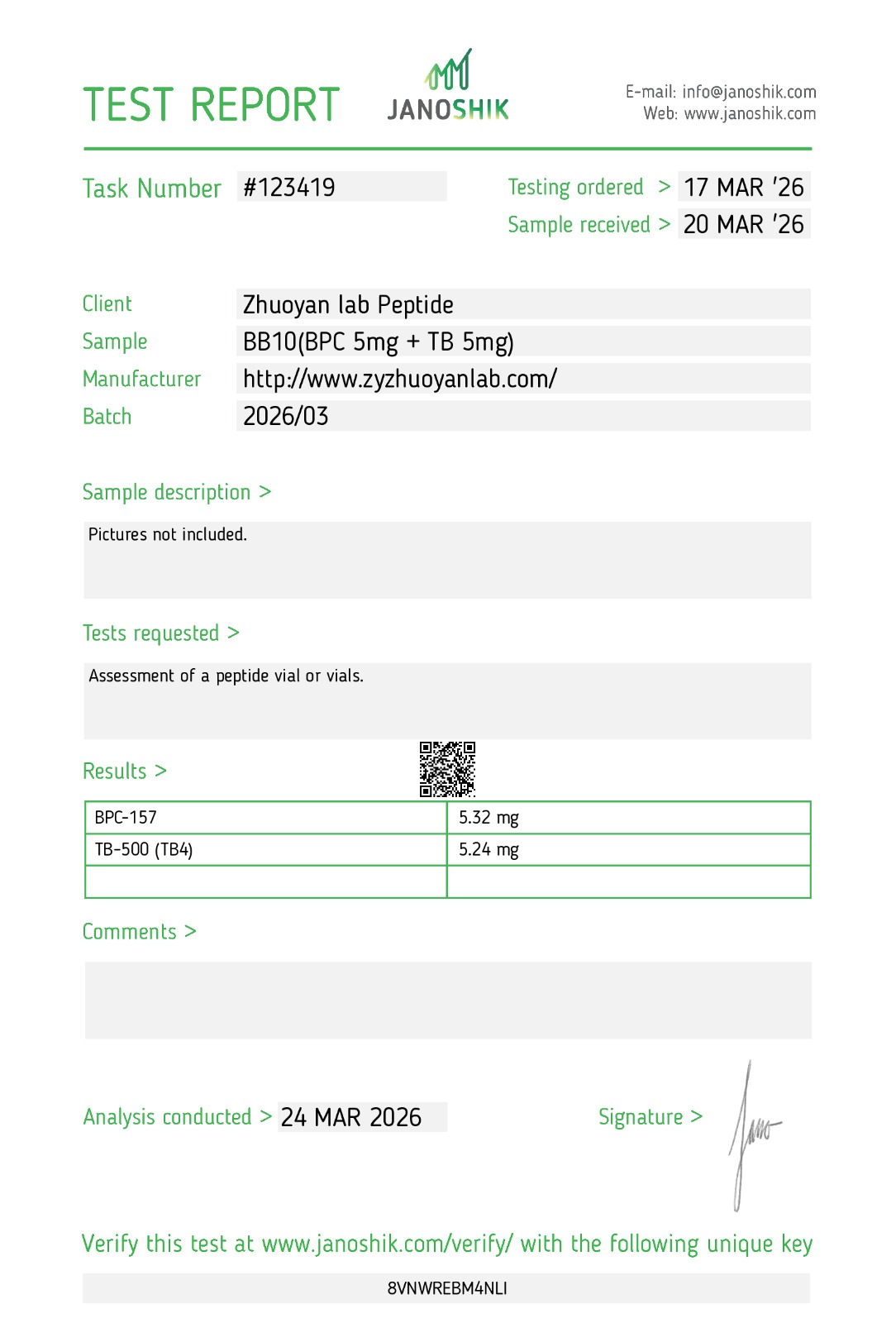
Every BPC-157 batch is tested
No smoke, no mirrors. Each batch is independently verified by Janoshik for purity, content and identity. Ask us and we will send the report.
How to research BPC-157 with NovaPeptides
At NovaPeptides, BPC-157 is supplied within the Wolverine Stack as a complete, ready-to-assemble research kit rather than a loose vial, with the reusable dosing pen, bacteriostatic water, needle heads, an extraction syringe and a thermal hard case, plus a verifiable Janoshik Certificate of Analysis. Because the right concentration depends on how much bacteriostatic water you reconstitute with, we keep the click-by-click method on a U-100 pen in one place.
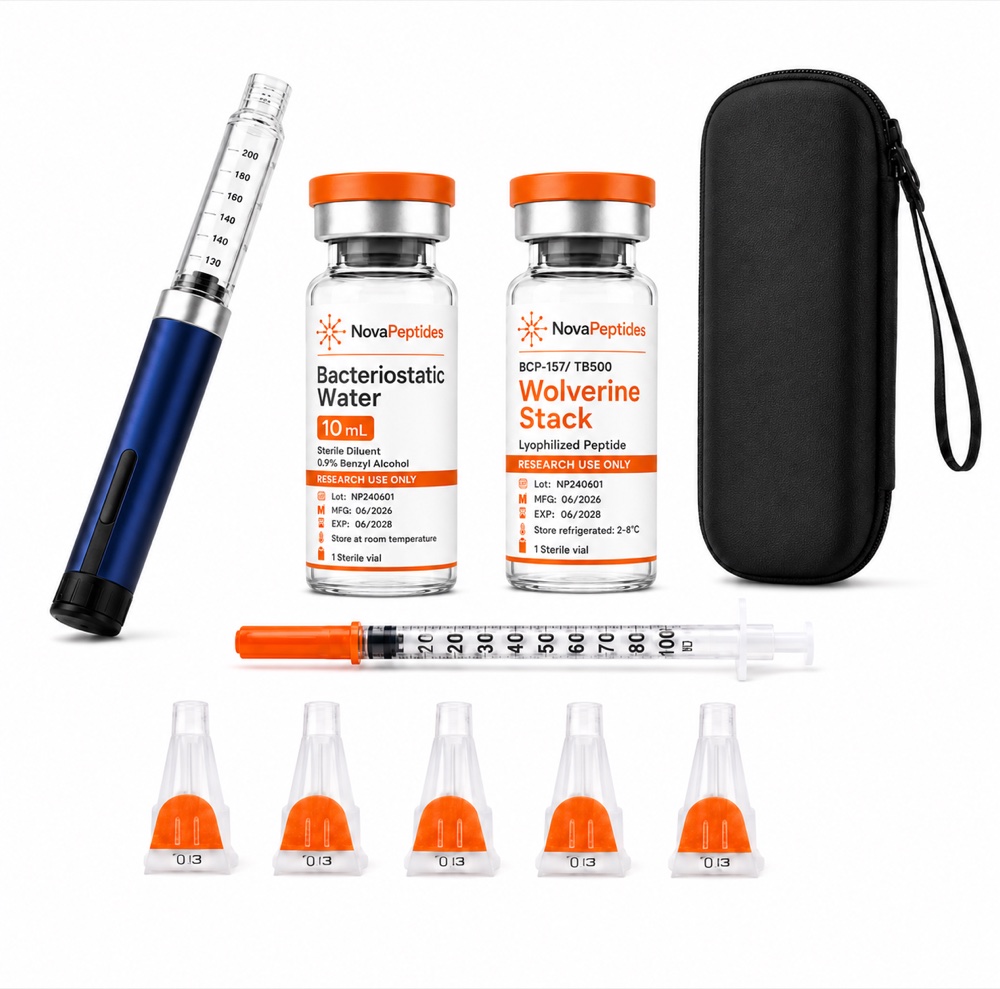
Wolverine Stack
Contains BPC-157, supplied as a complete, ready-to-assemble research kit. Research use only.
Enquire about BPC-157New to reconstitution? Our interactive pen and dosing guide shows how clicks convert to milligrams on a U-100 pen, with a switch for 2mL or 3mL of bacteriostatic water. It is provided for research reference only and is not a recommendation for human use. The dose you target is a decision for a qualified professional, not advice from us.
Frequently asked questions
Is BPC-157 legal in Australia?+
In Australia, BPC-157 is a scheduled substance: it is captured under Schedule 4 of the Poisons Standard, meaning it is regulated as a prescription-only medicine, not an over-the-counter product. It is not for human consumption outside a regulated clinical context, and it is also prohibited in sport under the WADA S0 category. NovaPeptides supplies it strictly for laboratory and educational research, framed in line with its scheduled status. Regulatory status can change, so confirming current rules is the researcher's responsibility, and any clinical question should go to a qualified healthcare professional.
What is BPC-157 researched for?+
In preclinical research, body protection compound 157 has been studied for tendon, ligament, muscle and gut tissue repair, as well as angiogenesis (new blood-vessel formation) and collagen-related repair. These are findings in animal and cell models, not proven human outcomes. It is supplied for research use only and is not a treatment for any condition.
Can I buy BPC-157 in Australia?+
BPC-157 is a Schedule 4 prescription-only substance under the Poisons Standard, so it is not an over-the-counter consumer product. NovaPeptides supplies BPC-157 within research kits, the Wolverine Stack, GLOW and KLOW, strictly for laboratory and educational research and framed in line with its scheduled status, each with a verifiable Janoshik Certificate of Analysis. It is not for human consumption, and enquiries are handled directly rather than through an online cart.
How does BPC-157 work in research models?+
The working model in the literature has two parts: supporting the blood supply through angiogenesis, VEGF signalling and the nitric oxide pathway, and supporting the structure through fibroblast activity and collagen organisation. These are research-model mechanisms studied to explain BPC-157, not confirmed effects in humans.
Is there human evidence for BPC-157?+
The evidence base is overwhelmingly preclinical, drawn from animal and cell studies. Large, robust human clinical trials are limited, so efficacy and long-term safety in people have not been established. The preclinical signal is consistent, but it has not been confirmed by the kind of human trials that would make BPC-157 an approved medicine.
How do I work out a BPC-157 dose?+
NovaPeptides does not publish fixed doses and does not give dosing advice. A specific target is a decision for a qualified professional. For the reconstitution and pen-click maths that turn a vial and a diluent volume into an accurate measurement, use the interactive pen and dosing guide. BPC-157 is supplied for research only and is not for human use.
How do I know NovaPeptides BPC-157 is research grade?+
Every batch is independently tested by Janoshik, a widely used independent peptide-analysis lab, and ships with a verifiable Certificate of Analysis reporting purity (typically by HPLC) and identity for that specific batch. You can request and read the COA. If a supplier cannot provide a batch-specific third-party COA, treat the purity claim as unverified.
Researching BPC-157?
Message us and we will walk you through BPC-157, the COA, reconstitution and how the kit goes together.
Chat with us on WhatsApp