
What Is TB-500? Thymosin Beta-4 Fragment Explained
TB-500 is a synthetic peptide closely related to Thymosin Beta-4 (often written TB4 or T-beta-4), a small protein found naturally throughout the body. Thymosin Beta-4 is one of the most abundant peptides in many tissues and is especially concentrated at sites of injury, where research has long been interested in its role in repair and regeneration. TB-500 is best understood as a laboratory-made fragment that carries the part of the Thymosin Beta-4 molecule most associated with its activity, which is why the two names are frequently used together in the literature.
The natural Thymosin Beta-4 protein is a single chain of roughly 43 amino acids. Researchers identified a short internal region of that chain, sometimes referred to as the actin-binding domain, as central to how the molecule behaves. The tb500 peptide supplied for research is a synthetic version built around this active region. Calling it a Thymosin Beta-4 fragment is accurate shorthand, though it is worth being precise that TB-500 and full-length TB4 are related rather than identical.
Naming note: in research and supplier catalogues, TB-500, thymosin beta-4 and TB4 peptide are often treated as interchangeable. Strictly, TB-500 refers to the synthetic active fragment, while Thymosin Beta-4 is the full naturally occurring protein. The shared chemistry is why the names travel together.
At NovaPeptides, TB-500 is not sold as a standalone vial. It is supplied within research blends where its repair-focused profile complements other peptides: the Wolverine Stack (BPC-157 and TB-500), and the GLOW and KLOW blends, which combine it with GHK-Cu and BPC-157. Every batch ships with a verifiable Janoshik Certificate of Analysis. As with everything in the catalogue, TB-500 is supplied strictly for research and educational use and is not approved for human consumption.
How TB-500 Is Studied to Work: Actin Binding and Cell Migration
The TB-500 mechanism of action that researchers focus on starts with a protein called actin. Actin is one of the fundamental building blocks of a cell's internal skeleton, and it is constantly assembling and disassembling as cells change shape, divide and move. Thymosin Beta-4, and by extension the TB-500 fragment, is studied as an actin-binding peptide: it interacts with actin monomers and is thought to influence how that internal scaffolding is organised.
This matters because of what cells do when tissue is disturbed in a research model. Repair depends heavily on TB-500 cell migration, the process by which cells travel to where they are needed, rearrange and rebuild. By interacting with the actin cytoskeleton, Thymosin Beta-4 has been investigated for its apparent role in helping cells reorganise and migrate. Much of the TB-500 tissue repair research builds on this single idea: support the machinery cells use to move, and you may support the broader process of repair that follows.
The processes researchers most often link to TB-500 in laboratory and animal studies
- Actin binding, the core interaction underpinning its studied effects on the cell skeleton
- Cell migration, helping cells move toward sites of disturbance in research models
- Angiogenesis, the formation of new blood vessels, investigated in tissue-repair contexts
- Reduction of inflammatory signalling in some experimental settings
- Modulation of cells involved in rebuilding connective and other tissue
It is important to keep the framing honest. These are mechanisms described in research and education references, largely from cell-culture and animal work. They describe what the peptide is studied to do, not a guaranteed effect in any individual. TB-500 is investigational, and no outcome should be assumed or promised from this body of work.
What TB-500 Is Researched For: Recovery, Flexibility and Tissue Repair
Recovery, examined at the cellular level. TB-500 recovery research is the headline reason the peptide draws interest, and it follows directly from the migration and repair mechanisms above. In animal and laboratory models, Thymosin Beta-4 has been investigated for its role in how soft tissues respond after they are disturbed, with researchers looking at muscle, tendon, ligament and skin contexts.
Flexibility is a second recurring theme. TB-500 flexibility is often discussed alongside its tissue-repair profile, because connective tissue health and range of motion are closely linked in the models studied. Researchers have explored whether supporting repair processes is associated with improved tissue quality in experimental settings. This remains a research question, framed as something investigated rather than demonstrated for any person.
Tissue repair is the unifying thread. Because Thymosin Beta-4 concentrates at sites of injury and interacts with the cell-migration machinery, a large share of the TB-500 tissue repair research treats it as a general repair-support candidate rather than something targeted at one structure. That breadth is exactly why it is so often combined with more localised peptides in research blends.
Recovery, studied from the inside out: TB-500 is researched as a whole-system repair candidate, not a one-tissue fix.
None of the above should be read as a claim that TB-500 treats, heals or prevents any condition. It is supplied for research and educational use only. The dose target in any research protocol is a decision for a qualified professional, and any general questions about reconstitution belong in the interactive pen guide rather than here.
TB-500 vs BPC-157: Key Differences in the Research
TB-500 vs BPC-157 is one of the most common comparisons in recovery-peptide research, partly because the two are so often mentioned in the same breath. They are studied for overlapping outcomes, recovery and tissue repair, but they come from different origins and are investigated through different mechanisms, which is precisely why researchers find them interesting together.
How the two peptides differ in the research literature
- Origin: TB-500 is a fragment related to Thymosin Beta-4, a naturally abundant protein; BPC-157 is a synthetic peptide derived from a sequence identified in gastric juice.
- Primary studied mechanism: TB-500 is investigated through actin binding and cell migration; BPC-157 is studied more for angiogenesis and localised tendon, ligament and gut-tissue repair signalling.
- Scope: TB-500 is often framed as a broad, whole-system repair candidate; BPC-157 is frequently described as more site-directed in research models.
- Half-life profile: TB-500 is generally discussed as the longer-acting of the two in research contexts, while BPC-157 is studied as shorter-acting.
- Research framing: both are investigational, research-use-only peptides, not approved medicines.
There is no single winner in the tb-500 vs bpc-157 question, because they are studied for complementary roles. Many research designs treat TB-500 as the systemic, migration-focused partner and BPC-157 as the localised repair partner. That complementarity is the entire rationale behind pairing them, which is the focus of the next section.
Why TB-500 and BPC-157 Are Commonly Paired in Research
The TB-500 BPC-157 stack is the most established pairing in recovery-peptide research, popular enough to have earned a nickname. At NovaPeptides it is supplied as the Wolverine Stack (BPC-157 and TB-500 in a single 10 mg vial), named for the idea of rapid regeneration. The logic is straightforward: combine a broad, migration-focused peptide with a more site-directed repair peptide and you cover two different parts of the repair picture studied in the literature.
Researchers pair them because their studied mechanisms sit side by side rather than on top of each other. TB-500 is investigated for cell migration and whole-system repair; BPC-157 is investigated for angiogenesis and localised connective-tissue support. The hypothesis explored in research is that the combination may be more comprehensive than either fragment alone, though, as always, this is a research question and not a promised result.
In the NovaPeptides catalogue, TB-500 appears in three research blends: the Wolverine Stack (BPC-157 and TB-500), GLOW (GHK-Cu, BPC-157 and TB-500), and KLOW (GHK-Cu, BPC-157, TB-500 and KPV). The GLOW and KLOW blends add GHK-Cu, the copper peptide studied for skin and hair, extending the repair theme beyond recovery alone.
Whichever blend a researcher works with, dosing is never specified on this page. Any tb-500 bpc-157 stack protocol, including how a blend is reconstituted and measured, belongs in the interactive pen guide, and the dose target itself is a decision for a qualified professional rather than guidance offered here.
TB-500 in Australia: Research-Use-Only and Regulatory Status
For anyone searching tb-500 australia, the most important point is the framing, not the chemistry. In Australia, TB-500 is handled as a research-use-only material. It is not an approved medicine, it is not registered for human use, and it is supplied strictly for research and educational purposes. NovaPeptides provides it on that basis and on no other.
The honest answer to is tb-500 legal in australia is that it is an investigational, research-use-only peptide rather than an approved therapeutic good, and it is not approved for human consumption. Peptides in this category are regulated, and the responsibility for understanding and complying with the relevant Australian rules sits with the researcher and their institution. This guide is education, not legal advice, and nothing here should be read as encouragement to use TB-500 outside a legitimate research context.
Research-use-only means exactly that. TB-500 is supplied for laboratory and educational research. It is not a supplement, not a medicine and not for human consumption. Confirm your obligations under Australian law before working with any research peptide.
What NovaPeptides can speak to with confidence is supply quality. Every batch that contains TB-500, across the Wolverine Stack, GLOW and KLOW blends, ships with a verifiable Janoshik Certificate of Analysis, so researchers can confirm identity and purity from independent third-party testing rather than taking a label at its word.
TB-500 Handling and Reconstitution: General Research Notes
TB-500 is supplied as a lyophilised (freeze-dried) powder, the standard format for research peptides because it keeps the material stable for transport and storage. Before any laboratory work, the powder is reconstituted, typically with bacteriostatic water, to bring it into solution. These are general handling notes shared for education, not a protocol or a recommendation to use the peptide in any particular way.
General handling principles researchers follow with peptides like TB-500
- Store the sealed, freeze-dried vial cool and away from light until it is needed.
- Reconstitute gently, directing the diluent down the side of the vial rather than forcing it onto the powder.
- Avoid vigorous shaking; swirl slowly and let the powder dissolve.
- Keep the reconstituted solution refrigerated and protected from light.
- Always cross-check identity and purity against the batch Certificate of Analysis.
This page does not provide doses. For reconstitution walk-throughs and how the Wolverine Stack, GLOW and KLOW blends are measured, use the interactive pen guide. The dose target for any research is a decision for a qualified professional, not advice given here.
On stability, peptides reconstituted in bacteriostatic water are generally treated as having a limited working window and are kept refrigerated. Because exact figures vary with concentration, storage and batch, this guide deliberately avoids quoting numbers that could be misleading. When precision matters, the Certificate of Analysis and the pen guide are the right references.
TB-500 Research FAQs: Half-Life, Sequence and Common Questions
A few questions come up repeatedly from researchers comparing the tb500 peptide against other recovery candidates. The answers below are framed for research and education only, and none describe a treatment or a promised outcome.
For anything touching dose or protocol, the interactive pen guide is the correct destination, and the dose target itself is always a decision for a qualified professional.
Verified by Janoshik
Every NovaPeptides batch, including the TB-500 in the Wolverine Stack, ships with a verifiable Janoshik Certificate of Analysis for identity, content and purity. Here is a real report.
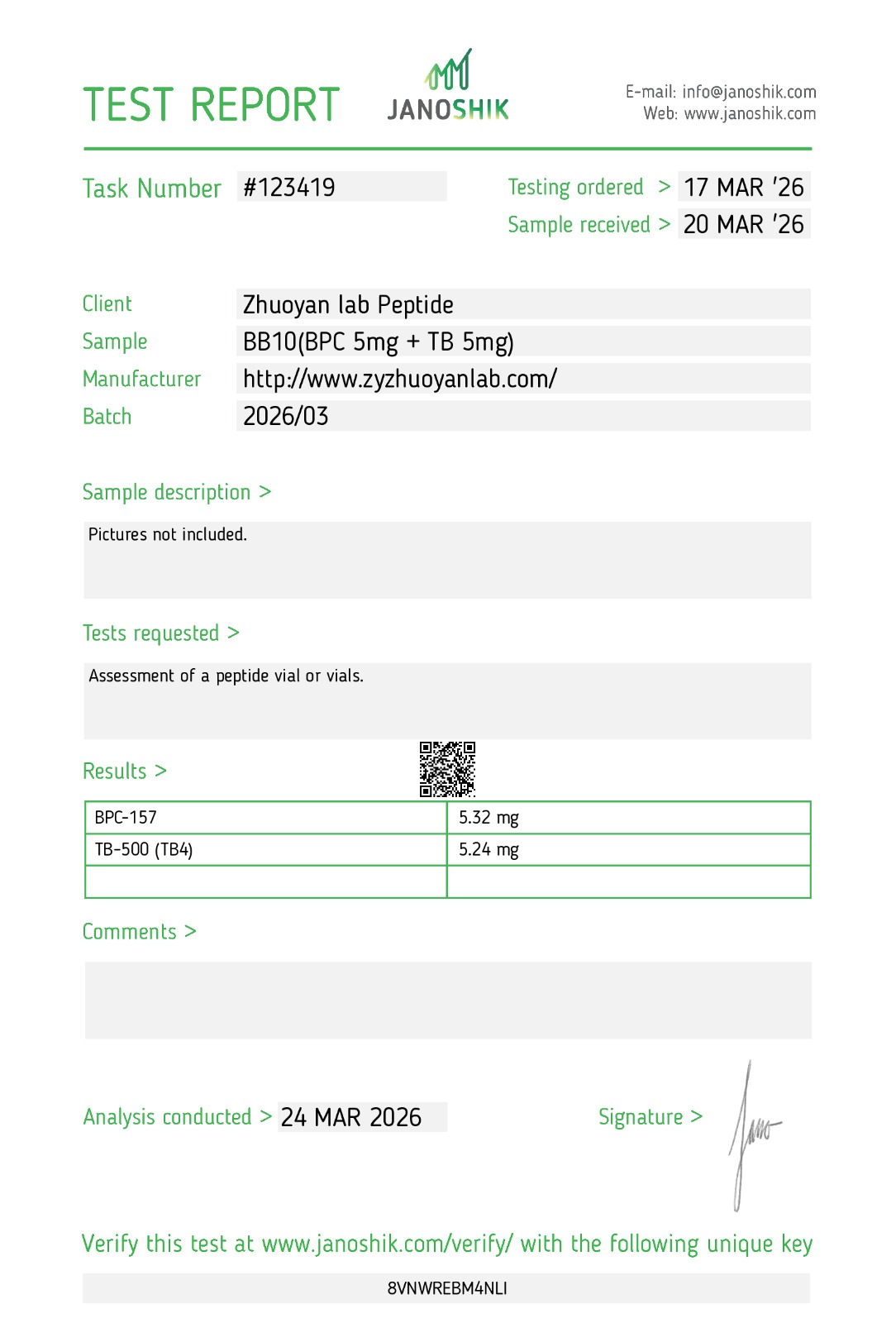
Every TB-500 batch is tested
No smoke, no mirrors. Each batch is independently verified by Janoshik for purity, content and identity. Ask us and we will send the report.
How to research TB-500 with NovaPeptides
At NovaPeptides, TB-500 is supplied within the Wolverine Stack as a complete, ready-to-assemble research kit rather than a loose vial, with the reusable dosing pen, bacteriostatic water, needle heads, an extraction syringe and a thermal hard case, plus a verifiable Janoshik Certificate of Analysis. Because the right concentration depends on how much bacteriostatic water you reconstitute with, we keep the click-by-click method on a U-100 pen in one place.
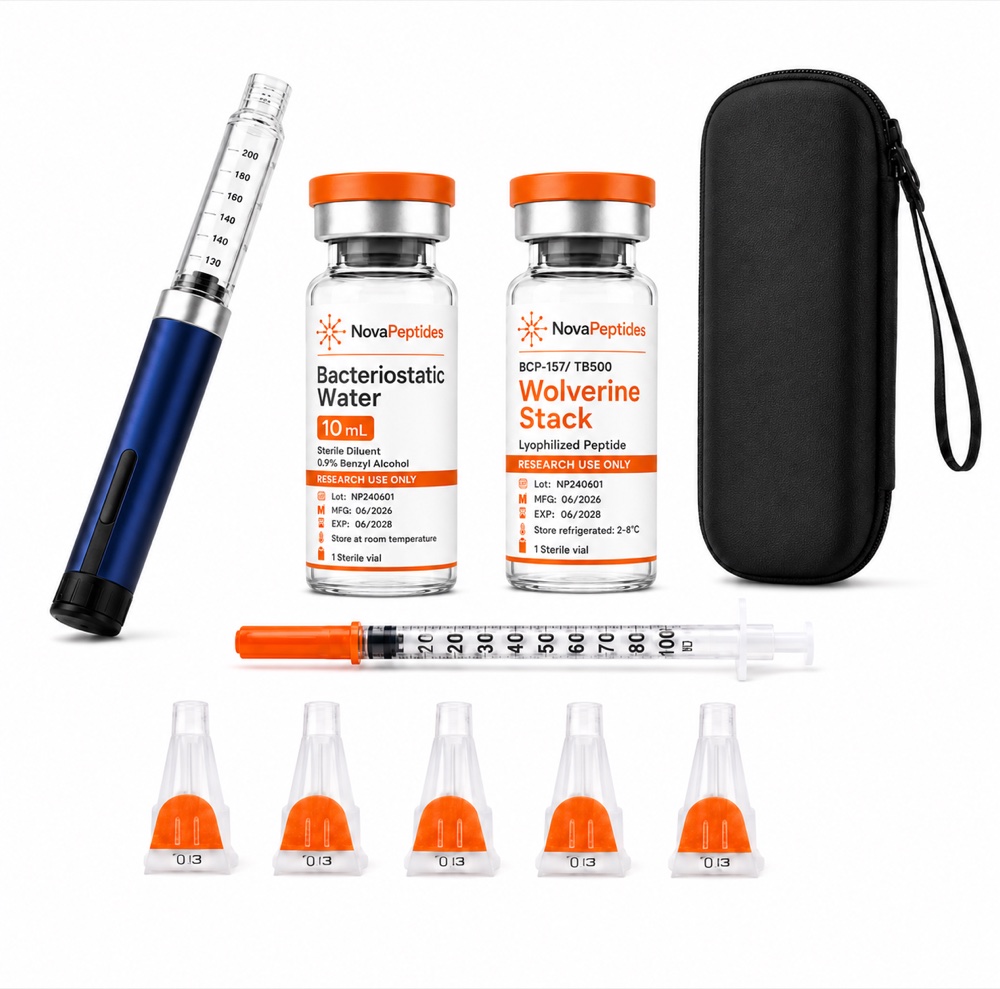
Wolverine Stack
Contains TB-500, supplied as a complete, ready-to-assemble research kit. Research use only.
Enquire about TB-500New to reconstitution? Our interactive pen and dosing guide shows how clicks convert to milligrams on a U-100 pen, with a switch for 2mL or 3mL of bacteriostatic water. It is provided for research reference only and is not a recommendation for human use. The dose you target is a decision for a qualified professional, not advice from us.
Frequently asked questions
What is TB-500 and how does it relate to thymosin beta-4?+
TB-500 is a synthetic peptide built around the active region of Thymosin Beta-4 (TB4), a small protein found naturally throughout the body and concentrated at sites of injury in research models. TB-500 is best described as a Thymosin Beta-4 fragment: closely related to the full protein and often referred to by the same names, though the two are not strictly identical. It is supplied for research and educational use only.
What is the TB-500 mechanism of action?+
The studied TB-500 mechanism of action centres on actin binding. Actin is a core building block of the cell's internal skeleton, and TB-500 is investigated as an actin-binding peptide that may influence how that scaffolding is organised. This is linked in research to TB-500 cell migration and, through it, to tissue-repair processes. These are mechanisms described in research models, not guaranteed effects.
What is the TB-500 half-life?+
In research discussions, TB-500 is generally described as the longer-acting member of the recovery-peptide pair when compared with BPC-157. Because precise tb-500 half life figures vary with the model, the route and the study, this guide does not quote a specific number rather than risk presenting a misleading one. Pharmacokinetic specifics are a matter for the primary research literature.
TB-500 vs BPC-157: which is better for recovery research?+
Neither is simply better; they are studied for complementary roles. TB-500 is investigated through actin binding and cell migration as a broad, whole-system repair candidate, while BPC-157 is studied more for localised tendon, ligament and gut-tissue repair. This complementarity is why researchers so often run them together as the TB-500 BPC-157 stack, supplied here as the Wolverine Stack.
Is TB-500 legal in Australia?+
TB-500 in Australia is handled as a research-use-only, investigational material. It is not an approved medicine, is not registered for human use and is not approved for human consumption. The responsibility for understanding and complying with the relevant Australian rules sits with the researcher and their institution. This is education, not legal advice.
How is TB-500 supplied at NovaPeptides, and is it quality tested?+
TB-500 is not sold standalone. It is supplied within three research blends: the Wolverine Stack (BPC-157 and TB-500), GLOW (GHK-Cu, BPC-157 and TB-500) and KLOW (GHK-Cu, BPC-157, TB-500 and KPV). Every batch ships with a verifiable Janoshik Certificate of Analysis confirming identity and purity through independent third-party testing, all for research and educational use only.
Does TB-500 come with dosing instructions?+
No. This page does not provide doses, and no mg or per-click figures are stated here. General reconstitution and how each blend is measured live in the interactive pen guide, and the dose target for any research protocol is a decision for a qualified professional rather than advice offered on this page.
Researching TB-500?
Message us and we will walk you through TB-500, the COA, reconstitution and how the kit goes together.
Chat with us on WhatsApp