
What Is KPV? The Alpha-MSH (11-13) Tripeptide Explained
Three amino acids, one tightly focused research story. KPV is a tripeptide built from lysine, proline and valine, which is exactly where its name comes from: K is the single-letter code for lysine, P for proline and V for valine. Put them in sequence and you get the lysine proline valine peptide that researchers simply call KPV.
What makes KPV interesting is its parentage. It is the C-terminal fragment, positions 11 to 13, of alpha-melanocyte-stimulating hormone (alpha-MSH), a naturally occurring signalling molecule your body already produces. Alpha-MSH is a 13-amino-acid hormone best known for its role in pigmentation, but it has also been studied extensively for its anti-inflammatory behaviour. The intriguing finding behind decades of KPV peptide research is that much of that calming, anti-inflammatory activity appears to survive in just the final three residues. In other words, the alpha-MSH tripeptide seems to keep a meaningful slice of the parent hormone's signalling story while shedding the pigmentation-related portion.
That is why KPV is generally grouped as an anti-inflammatory peptide rather than a growth, repair or metabolic one. It is small, it is stable enough to be of practical research interest, and it gives investigators a clean way to ask a specific question: how much of alpha-MSH's effect on inflammation can a minimal fragment reproduce in a controlled model?
KPV is supplied by NovaPeptides strictly for laboratory and educational research. It is investigational, not approved for human consumption, and nothing on this page describes a treatment, therapy or medicine.
How KPV Is Studied to Work: PepT1 Entry and the NF-kB Pathway
The mechanism researchers most often describe for KPV has two halves: how the peptide is thought to get into cells, and what it is studied to do once it is there.
On entry, a recurring theme in the literature is the PepT1 transporter (peptide transporter 1, also written PEPT1). PepT1 is a transport protein that normally shuttles small di- and tripeptides across cell membranes, and it is expressed in the intestinal lining and, notably, becomes more present on certain immune cells in inflamed tissue. Because KPV is itself a tripeptide, it fits the kind of cargo PepT1 carries. Researchers have proposed that the kpv pept1 transporter route is one way the peptide reaches the inside of gut and immune cells precisely where inflammation is concentrated, which is an appealing feature for a molecule being investigated in gut models.
Once inside, the headline pathway is NF-kB. NF-kB (nuclear factor kappa B) is a master switch that, when activated, drives cells to produce pro-inflammatory cytokines, the chemical messengers that amplify and sustain inflammation. In cell and animal studies, the kpv nf-kb pathway story is that KPV is investigated for dampening NF-kB activation, which in turn is associated with lower output of those inflammatory signals. This is the core reason KPV is described as a kpv anti-inflammatory peptide: the research interest centres on turning the volume down on an over-active inflammatory signal rather than stimulating new tissue.
The KPV research mechanism, in plain terms
- Origin: KPV is the last three amino acids of alpha-MSH, a hormone already studied for anti-inflammatory activity.
- Entry: as a tripeptide, it is studied to enter cells partly via the PepT1 transporter, which is upregulated at sites of inflammation.
- Action: inside the cell, it is investigated for reducing activation of the NF-kB pathway.
- Result in models: lower NF-kB signalling is associated in studies with reduced pro-inflammatory cytokine production.
Every step above describes what KPV is studied to do in laboratory and animal models. None of it is a claim about what KPV does in people, and none of it should be read as a treatment outcome.
KPV and Gut Inflammation: What the Research Models Show
The gut is where KPV has drawn the most attention. The logic is elegant: an inflamed intestine shows increased PepT1 expression, KPV is a PepT1-compatible tripeptide, and the NF-kB pathway it is studied to modulate is central to inflammatory bowel conditions. That combination has made KPV a natural candidate for kpv gut research.
Much of the work sits in colitis research. In animal models of colitis, where the colon is deliberately inflamed to mimic features of inflammatory bowel disease, KPV has been investigated for its association with reduced markers of inflammation and changes in markers of intestinal tissue condition in those models. Researchers in this kpv colitis research space have also explored delivery questions, such as nanoparticle and oral formulations designed to carry the peptide to the colon, precisely because PepT1-mediated uptake makes targeted gut delivery a live experimental question.
It is worth being precise about what this body of work is and is not. These are preclinical models, primarily in cells and rodents. They are valuable for understanding mechanism and for generating hypotheses, and they are the reason KPV is so often discussed alongside gut inflammation. They are not evidence that KPV treats any human digestive condition, and KPV is not an approved therapy for colitis, inflammatory bowel disease or any other illness.
An inflamed gut over-expresses the very transporter KPV is studied to travel through, which is part of why the gut has become the peptide's most-researched arena.
KPV and Skin Inflammation: Eczema, Acne and Barrier Research
Skin is the second major research arena for KPV, and for related reasons. Alpha-MSH, the parent hormone, has a long-studied relationship with skin biology, and the inflammatory signalling that KPV is investigated to modulate is heavily involved in inflammatory skin conditions. That has positioned KPV as a candidate of interest in kpv skin research.
In this space, researchers have looked at KPV in the context of inflammatory and barrier-related skin models. Work touching on kpv eczema research, as well as exploratory interest around acne and general skin-barrier and wound contexts, tends to focus on the same theme seen in the gut: whether reducing NF-kB-driven inflammatory signalling is associated with calmer, less reactive tissue in a controlled setting. Some of this interest is also topical, since a small, stable tripeptide is an attractive molecule for formulation studies.
Skin-related research themes for KPV
- Inflammatory skin models, where the question is whether KPV is associated with reduced inflammatory signalling.
- Eczema and barrier-focused research, exploring KPV's behaviour in irritated or compromised skin models.
- Acne-adjacent and wound-context interest, again centred on the anti-inflammatory mechanism rather than any proven outcome.
- Formulation studies, since a small tripeptide is a practical candidate for topical and delivery research.
As with the gut, the honest framing is that this is investigational. KPV is studied for skin inflammation in research models; it is not a skincare ingredient cleared for human use here, and it does not treat eczema, acne or any skin disease.
KPV vs BPC-157 and Alpha-MSH: How the Research Compares
KPV is easiest to understand next to its neighbours. The most common comparison researchers ask about is kpv vs bpc-157, partly because both appear together in NovaPeptides' KLOW blend.
BPC-157 is a longer peptide, a 15-amino-acid sequence derived from a protein found in gastric juice, and it is most often studied in the context of tissue and tendon repair, gut lining integrity and angiogenesis, the formation of new blood vessels. KPV, by contrast, is a three-amino-acid alpha-MSH fragment whose research identity is almost entirely about modulating inflammatory signalling through the NF-kB pathway. A useful mental model: BPC-157 is studied more around repair and rebuilding, while KPV is studied more around calming an inflammatory signal. The two are investigated for complementary, not identical, roles, which is exactly the rationale for combining them.
Against its own parent, alpha-MSH, KPV is essentially the minimalist version. Alpha-MSH carries both pigmentation-related and anti-inflammatory activity across its 13 residues; KPV keeps just the C-terminal three and, in the research, retains a meaningful portion of the anti-inflammatory behaviour while leaving the pigmentation portion behind. That is the appeal of the alpha-msh tripeptide as a research tool: a smaller, more focused molecule that lets investigators isolate the inflammatory question.
At a glance: KPV, BPC-157 and alpha-MSH
- KPV (Lys-Pro-Val): a 3-amino-acid alpha-MSH fragment, studied chiefly for anti-inflammatory signalling via NF-kB and PepT1.
- BPC-157: a 15-amino-acid gastric-derived peptide, studied chiefly for tissue repair, gut lining and angiogenesis.
- Alpha-MSH: the 13-amino-acid parent hormone, studied for both pigmentation and broad anti-inflammatory activity.
- Why combine: KPV and BPC-157 are investigated for complementary roles, calming inflammation versus supporting repair.
Research Status in Australia: Investigational and Research-Use-Only
For anyone searching kpv peptide australia, the regulatory framing matters as much as the science. KPV is an investigational research peptide. It is not an approved medicine in Australia, it is not a registered therapeutic good, and it is supplied strictly for laboratory and educational research, not for human consumption. NovaPeptides is an education and catalogue resource, and KPV is presented here in that spirit: as a molecule to understand, not a product to use on yourself.
This is the responsible position for any kpv anti-inflammatory peptide discussion. The published interest in gut and skin inflammation is real and worth understanding, but it lives almost entirely in preclinical models. Treating that preclinical work as if it were clinical guidance would be a mistake. The accurate statement is simply that KPV is being researched, and that any decision about handling it belongs to a qualified professional working in an appropriate research context.
Research-use-only means exactly that. KPV is investigational, not approved for human consumption, and is supplied for research and educational use. Nothing here is medical advice or a recommendation to use this peptide.
Quality and Verification: KPV in the KLOW Blend with a Janoshik COA
At NovaPeptides, KPV is supplied as one of the four peptides in the KLOW blend, alongside GHK-Cu, BPC-157 and TB-500. KLOW takes GLOW's repair trio and adds KPV specifically for its researched role in calming inflammation in gut and skin models, which is why KPV pairs with the GLOW peptides (GHK-Cu, BPC-157, TB-500) in a single research blend. If you are researching KPV, the KLOW vial is where you will find it here rather than as a standalone.
Verification is the part that should never be hand-waved. Every KLOW batch ships with a Janoshik Certificate of Analysis (COA), an independent third-party laboratory report that confirms what is actually in the vial. The KLOW COA itemises each peptide, including the KPV content, so the research peptide you are studying is the research peptide you were told you would receive. Independent third-party testing is the single most important quality signal for any research peptide, and it is the standard NovaPeptides holds every batch to.
What the Janoshik COA gives you
- Independent, third-party analysis of each batch, not an in-house claim.
- Itemised content for every peptide in the KLOW blend, KPV included.
- A verifiable record that the contents match the label.
- A consistent quality benchmark applied to every batch we supply.
A current Janoshik Certificate of Analysis for the KLOW blend is available on request, so the KPV content can be independently verified.
Handling, Reconstitution and Research Context (No Dosing Advice)
Because KPV here lives inside the KLOW blend, handling follows the same general principles as the other peptides in that vial. Lyophilised (freeze-dried) research peptides are typically kept cool and dry, reconstituted with an appropriate sterile diluent for laboratory work, and handled with clean technique to preserve integrity. These are general research-handling notes, not instructions for use in or on a human.
On the question everyone eventually asks, how much, this guide deliberately does not state doses. There are no mg-per-click figures here, no protocols and no schedules, because the right amount in any research context is a decision for a qualified professional, not something a catalogue page should dictate. We do not invent numbers, and we will not pretend a one-size figure exists.
For the interactive reconstitution and pen calculations relevant to the KLOW blend, use the dedicated pen guide, which handles the arithmetic in a controlled, research-framed way. It is the correct place for any quantity question, and it keeps dosing decisions where they belong, with the researcher and their professional judgement.
Dosing questions belong in the interactive pen guide, not on this page. The dose target is always a decision for a qualified professional, and nothing here should be treated as a protocol or as advice.
Verified by Janoshik
Every NovaPeptides batch, including the KPV in the KLOW blend, ships with a verifiable Janoshik Certificate of Analysis for identity, content and purity. Here is a real report.
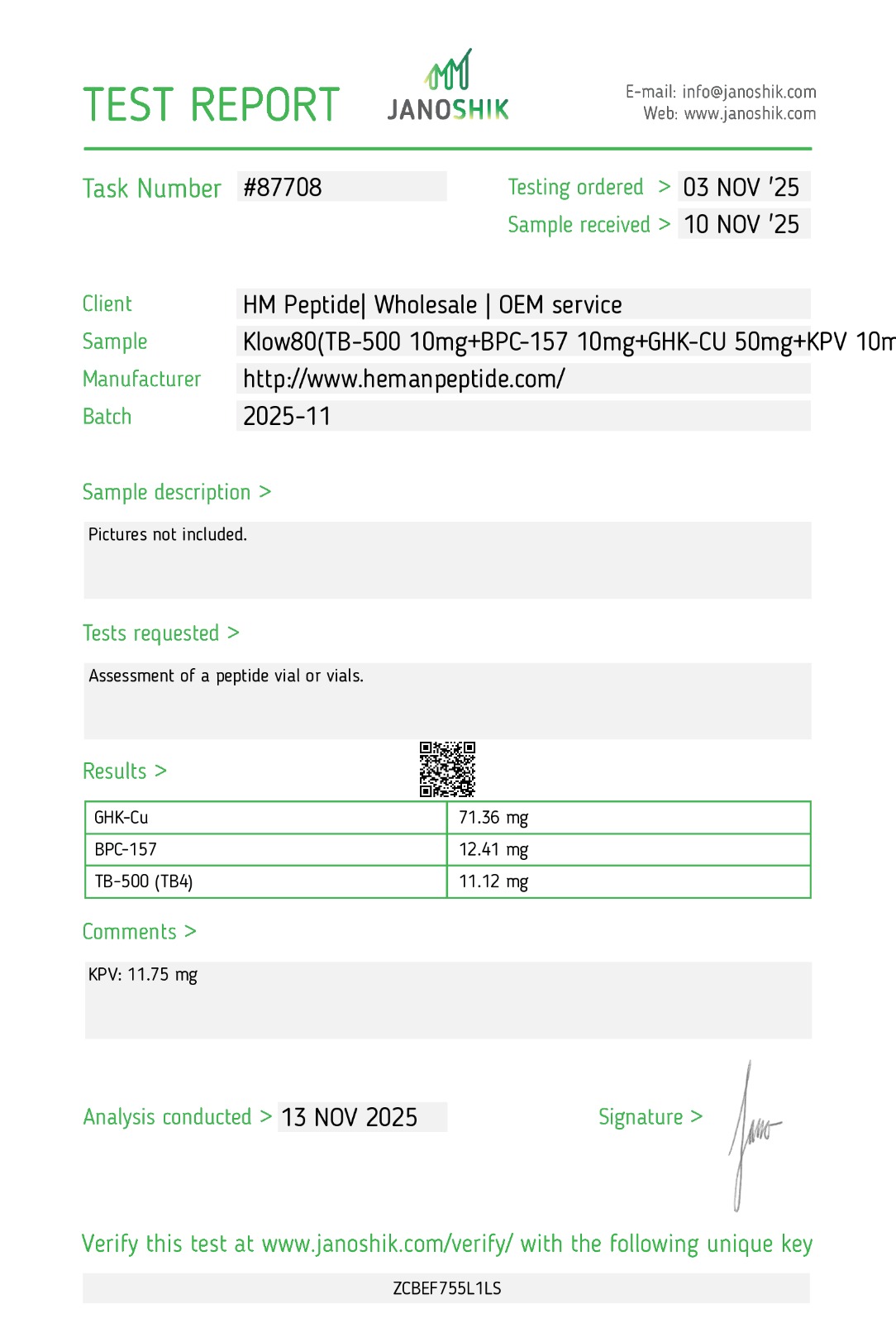
Every KPV batch is tested
No smoke, no mirrors. Each batch is independently verified by Janoshik for purity, content and identity. Ask us and we will send the report.
How to research KPV with NovaPeptides
At NovaPeptides, KPV is supplied within the KLOW blend as a complete, ready-to-assemble research kit rather than a loose vial, with the reusable dosing pen, bacteriostatic water, needle heads, an extraction syringe and a thermal hard case, plus a verifiable Janoshik Certificate of Analysis. Because the right concentration depends on how much bacteriostatic water you reconstitute with, we keep the click-by-click method on a U-100 pen in one place.
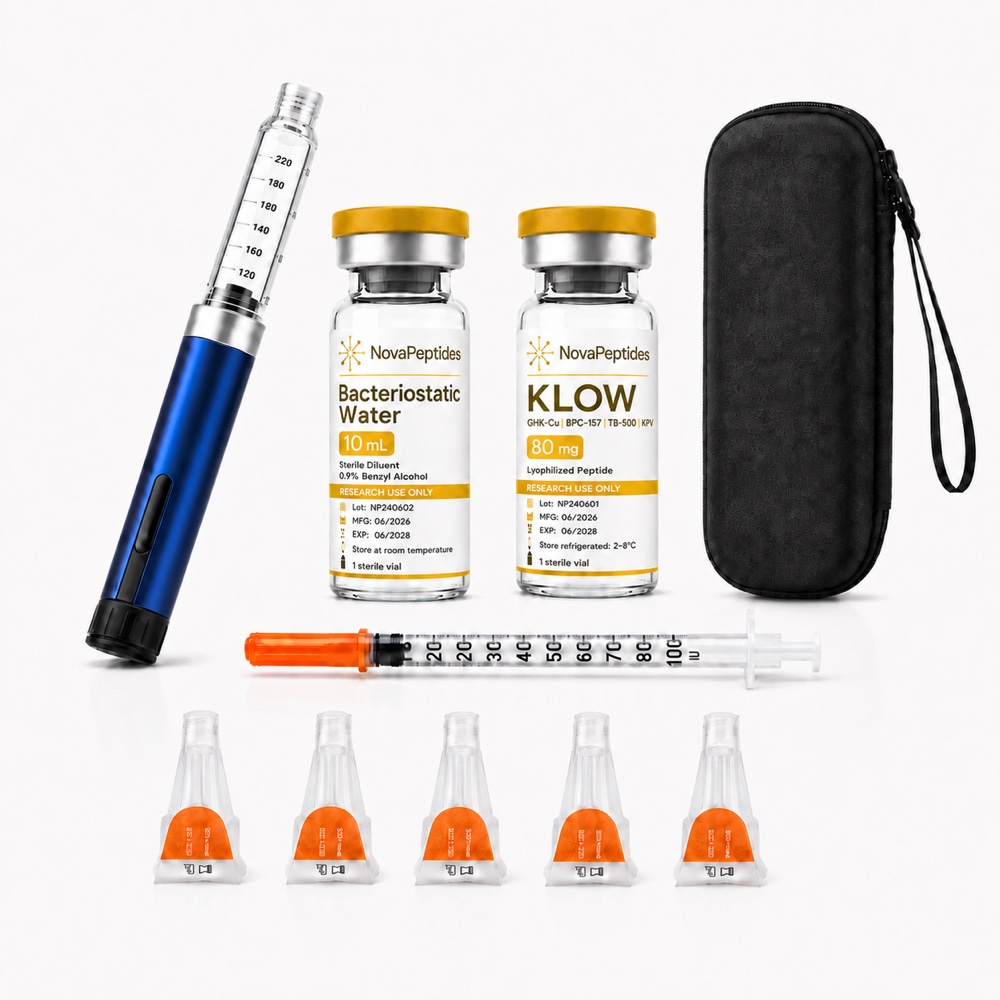
KLOW blend
Contains KPV, supplied as a complete, ready-to-assemble research kit. Research use only.
Enquire about KPVNew to reconstitution? Our interactive pen and dosing guide shows how clicks convert to milligrams on a U-100 pen, with a switch for 2mL or 3mL of bacteriostatic water. It is provided for research reference only and is not a recommendation for human use. The dose you target is a decision for a qualified professional, not advice from us.
Frequently asked questions
What is the KPV peptide?+
KPV is a tripeptide made of lysine, proline and valine (Lys-Pro-Val). It is the C-terminal fragment, positions 11 to 13, of the hormone alpha-MSH, and it is studied as an anti-inflammatory research peptide, particularly in gut and skin models. It is investigational and supplied for research and educational use only, not for human consumption.
How is KPV studied to work?+
In laboratory and animal models, KPV is investigated for entering cells partly via the PepT1 transporter, which is more present at sites of inflammation, and for reducing activation of the NF-kB pathway, a master switch for inflammatory signalling. Lower NF-kB activation is associated in studies with reduced production of pro-inflammatory messengers. This describes research-model behaviour, not an effect in people.
What is the difference between KPV and BPC-157?+
BPC-157 is a 15-amino-acid gastric-derived peptide studied mainly for tissue repair, gut lining integrity and blood-vessel formation. KPV is a 3-amino-acid alpha-MSH fragment studied mainly for calming inflammatory signalling through the NF-kB pathway. They are researched for complementary roles, which is why both appear together in the KLOW blend. Neither statement is a medical claim.
Is KPV studied for gut and skin conditions?+
KPV has been investigated in preclinical gut models, including colitis research, and in inflammatory and barrier-related skin models such as eczema research. These are cell and animal studies that explore mechanism and generate hypotheses. They are not evidence that KPV treats any human condition, and KPV is not an approved therapy for any disease.
Is KPV legal and approved in Australia?+
KPV is an investigational research peptide. It is not an approved medicine or registered therapeutic good in Australia and is supplied strictly for laboratory and educational research, not for human consumption. Any handling decision belongs to a qualified professional in an appropriate research setting.
How is KPV quality verified at NovaPeptides?+
KPV is supplied within the KLOW blend (GHK-Cu, BPC-157, TB-500, KPV), and every batch ships with an independent Janoshik Certificate of Analysis. The COA itemises each peptide, including the KPV content, so the contents are verified against the label by a third-party laboratory. A current COA is available on request.
What dose of KPV should I use?+
This guide does not provide doses, and there are no mg-per-click figures here. The appropriate amount in any research context is a decision for a qualified professional, not advice from a catalogue page. For reconstitution and pen calculations relevant to the KLOW blend, use the interactive pen guide.
Researching KPV?
Message us and we will walk you through KPV, the COA, reconstitution and how the kit goes together.
Chat with us on WhatsApp