
What Is Retatrutide? The Triple Agonist Explained (LY3437943, RT60, Triple G)
One molecule, three targets. Retatrutide is a synthetic peptide that activates three separate metabolic receptors at once, and it is studied in clinical trials for body weight reduction and broader metabolic outcomes. It carries the developmental code LY3437943 and is nicknamed the "Triple G" for the three pathways it engages. At NovaPeptides it is supplied as a lyophilised research powder, in the kit designated RT60, for research use only.
Structurally, retatrutide is a single-chain peptide engineered with a fatty acid side chain. That lipid tail lets it bind to albumin in the bloodstream, which slows clearance and extends how long the molecule stays active. The design borrows from the same family of incretin-based research compounds as semaglutide and tirzepatide, but retatrutide goes one receptor further by adding glucagon activity to the mix.
The headline distinction is simple. Earlier research peptides hit one or two receptors. Retatrutide is the first widely studied agonist to engage all three of GLP-1, GIP and glucagon in a single sequence, which is why the research community pays close attention to what is, on paper, a more ambitious approach to metabolic signalling.
Naming made simple: "Retatrutide", "LY3437943", "Triple G peptide" and "RT60 peptide" all refer to the same compound. RT60 is simply the NovaPeptides kit designation for the research material, supplied for research use only.
How Retatrutide Works: GLP-1, GIP and Glucagon Receptors
To understand how retatrutide works, it helps to take the three receptors one at a time. Each is a well-characterised part of the body's metabolic and appetite signalling system, and retatrutide is designed to switch on all three together.
The three receptors retatrutide targets
- GLP-1 (glucagon-like peptide-1): the most familiar incretin pathway. In research, GLP-1 receptor activation is associated with slowed gastric emptying, reduced appetite signalling and improved glucose-dependent insulin response.
- GIP (glucose-dependent insulinotropic polypeptide): a second incretin receptor. GIP activity is studied for its role in insulin secretion and in how the body handles fat and energy storage, and it is thought to complement GLP-1 effects.
- Glucagon receptor: the addition that makes retatrutide a triple agonist. Glucagon signalling is investigated for its influence on energy expenditure and how the body mobilises stored energy, which is the mechanism researchers believe sets retatrutide apart from dual agonists.
The research rationale is that engaging appetite suppression (largely GLP-1 and GIP) alongside increased energy output (the glucagon arm) could produce a larger net effect on body weight than appetite suppression alone. That is the hypothesis under investigation. It is studied, not settled, and retatrutide remains an investigational compound rather than an approved therapy.
Appetite down, energy expenditure up: that dual lever, across three receptors, is the mechanism retatrutide is being researched to exploit.
What Retatrutide Is Researched For: Weight and Metabolic Outcomes
Retatrutide weight loss research is the headline use, and it is the focus of most published trial work to date. The compound has been investigated primarily for body weight reduction and for related metabolic markers, with study populations including participants with obesity and participants with type 2 diabetes.
Beyond body weight, the research interest extends to metabolic outcomes such as glucose regulation and markers associated with fatty liver. These are areas of active investigation, framed as outcomes measured in trials, not as guaranteed results or approved indications.
Important, and specific to this compound: retatrutide is studied for fat loss and metabolic outcomes, not muscle gain. As with other agents that drive substantial weight reduction, a portion of the weight lost in studies can include lean mass. Retatrutide should never be framed as a muscle-building peptide. It is the opposite category of research interest.
It is worth stating plainly what the research does not establish. Retatrutide is not approved as a medicine in Australia or elsewhere, it is not a treatment you can be prescribed, and no outcome is promised. Every efficacy statement here is hedged for a reason: the data describes what was measured in controlled study settings, and individual research questions are decisions for qualified professionals to design and interpret.
Retatrutide vs Tirzepatide: Triple Agonist vs Dual Agonist Compared
The retatrutide vs tirzepatide comparison comes up constantly, because the two are close cousins from the same research lineage. The cleanest way to frame it is by receptor count. Tirzepatide is a dual agonist. Retatrutide is a triple agonist. That single difference, the added glucagon receptor, is the crux of the comparison.
Triple agonist vs dual agonist at a glance
- Receptors engaged: tirzepatide activates GLP-1 and GIP (two pathways). Retatrutide activates GLP-1, GIP and glucagon (three pathways).
- The differentiator: retatrutide adds the glucagon arm, which is researched for its role in energy expenditure rather than appetite alone.
- Research maturity: tirzepatide has a longer and broader body of published data. Retatrutide is newer and still earlier in its research timeline.
- Shared lineage: both are long-acting peptides built with albumin-binding chemistry, and both are studied for weight and metabolic outcomes.
What the comparison does not give you is a verdict. It would be irresponsible to declare one compound superior, because they sit at different stages of investigation and the trials are not directly interchangeable. The accurate takeaway is mechanistic: retatrutide is being researched to test whether adding glucagon activity to a GLP-1/GIP backbone meaningfully changes metabolic outcomes versus a dual agonist.
Retatrutide in the Research Trials: What the Data Shows So Far
Retatrutide as a research peptide has been studied through a structured clinical trial programme, progressing through early-phase safety and dose-finding work into larger studies focused on body weight and metabolic endpoints. The general arc of the published research is what you would expect for a compound of this class: establish tolerability and dosing first, then measure efficacy outcomes in defined populations.
Across this work, retatrutide has been associated with notable reductions in body weight in study participants, alongside changes in metabolic markers. We are deliberately not quoting specific percentage figures here, because those numbers depend heavily on study design, dose, duration and population, and presenting a single headline statistic would misrepresent a moving body of research. The honest summary is that the trial data has been considered sufficient to advance the compound through its development programme.
On tolerability, the side effect profile reported in trials has been broadly consistent with the incretin class, with gastrointestinal effects being the most commonly described. As an investigational compound, its full long-term profile is still being characterised. (Research and education references.)
How to read trial data responsibly: results reported in a controlled trial describe that study, under that protocol. They are not a promise of any outcome and they do not make retatrutide an approved or recommended product. Treat published findings as research signals, not instructions.
Retatrutide in Australia: Legal and Research-Use-Only Status
Here is the retatrutide legal status Australia question answered directly and without spin. Retatrutide is an investigational compound. It is not approved by the Therapeutic Goods Administration for human use, it is not registered as a medicine, and it is not sold or supplied for human consumption. At NovaPeptides it is supplied strictly for research and educational use only.
What that means in practice for an Australian researcher is straightforward. Retatrutide research use only is not a marketing slogan, it is the defining condition of supply. The compound is intended for in-vitro and laboratory research contexts. It is not for ingestion, not for injection into humans or animals as a therapy, and nothing on this page should be read as encouragement to use it that way.
We keep this framing deliberately conservative because the science deserves honesty and the law deserves respect. If your interest is personal health rather than research, the correct next step is a conversation with a qualified Australian healthcare professional about approved options, not the purchase of a research compound.
Research use only is the whole sentence, not the fine print.
Handling, Storage and Reconstitution Considerations for Researchers
Retatrutide is supplied as a lyophilised (freeze-dried) powder, which is the stable form for transport and storage. Like most research peptides, it is sensitive to heat, light and repeated freeze-thaw cycles, so careful handling protects the integrity of the material you are working with.
General handling and storage notes for researchers
- Store the lyophilised powder cold and protected from light, following standard peptide handling practice, until it is prepared for use.
- Reconstitute with an appropriate sterile diluent such as bacteriostatic water, added gently down the side of the vial rather than directly onto the powder, swirling rather than shaking.
- Once reconstituted, keep the solution refrigerated and minimise temperature swings and repeated freeze-thaw cycles, which can degrade peptide integrity.
- Label, date and record everything. Reproducible research depends on a clean, documented preparation log.
On dosing: we do not publish mg or click figures on this page, by design. Reconstitution volume and any dose target are decisions for a qualified professional, not something to copy from a guide. For the reconstitution and pen mechanics, use the interactive pen guide, which walks through the maths transparently rather than handing you a number to assume.
All of the above is general laboratory-practice guidance for handling a research peptide, not instructions for human use. The material is supplied for research and educational purposes only.
Quality and Verification: Independent Janoshik Testing
Purity is not a claim you should take on faith, which is why every batch is independently tested. The retatrutide supplied by NovaPeptides is sent to Janoshik, the independent analysis lab the wider peptide research community treats as a trusted reference for identity and purity testing, and a Certificate of Analysis is available on request.
The point of an independent COA is verifiability. Rather than asking you to trust a number printed on a page, the report itself is the evidence: you can request the actual Janoshik certificate, read the identity and purity figures in black and white, and confirm them against the lab's own verification records. A research result is only as trustworthy as the material behind it, and a verifiable certificate is how that trust is earned rather than asserted.
As with everything on this site, the material is supplied for research and educational use only and is not for human consumption.
Verified by Janoshik
Every NovaPeptides batch, including the Retatrutide in the RT60 research kit, ships with a verifiable Janoshik Certificate of Analysis for identity, content and purity. Here is a real report.
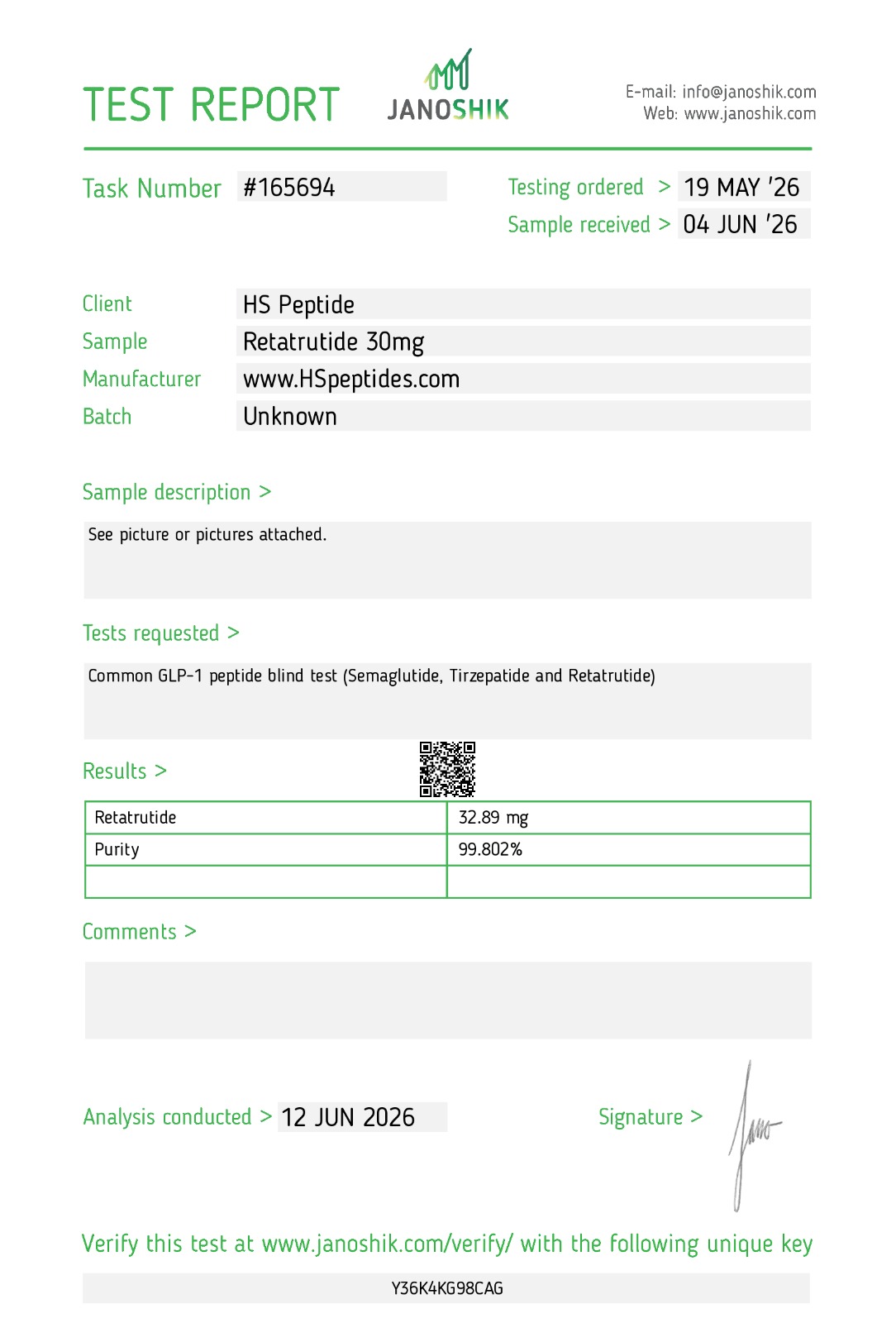
Every Retatrutide batch is tested
No smoke, no mirrors. Each batch is independently verified by Janoshik for purity, content and identity. Ask us and we will send the report.
How to research Retatrutide with NovaPeptides
At NovaPeptides, Retatrutide is supplied within the RT60 research kit as a complete, ready-to-assemble research kit rather than a loose vial, with the reusable dosing pen, bacteriostatic water, needle heads, an extraction syringe and a thermal hard case, plus a verifiable Janoshik Certificate of Analysis. Because the right concentration depends on how much bacteriostatic water you reconstitute with, we keep the click-by-click method on a U-100 pen in one place.
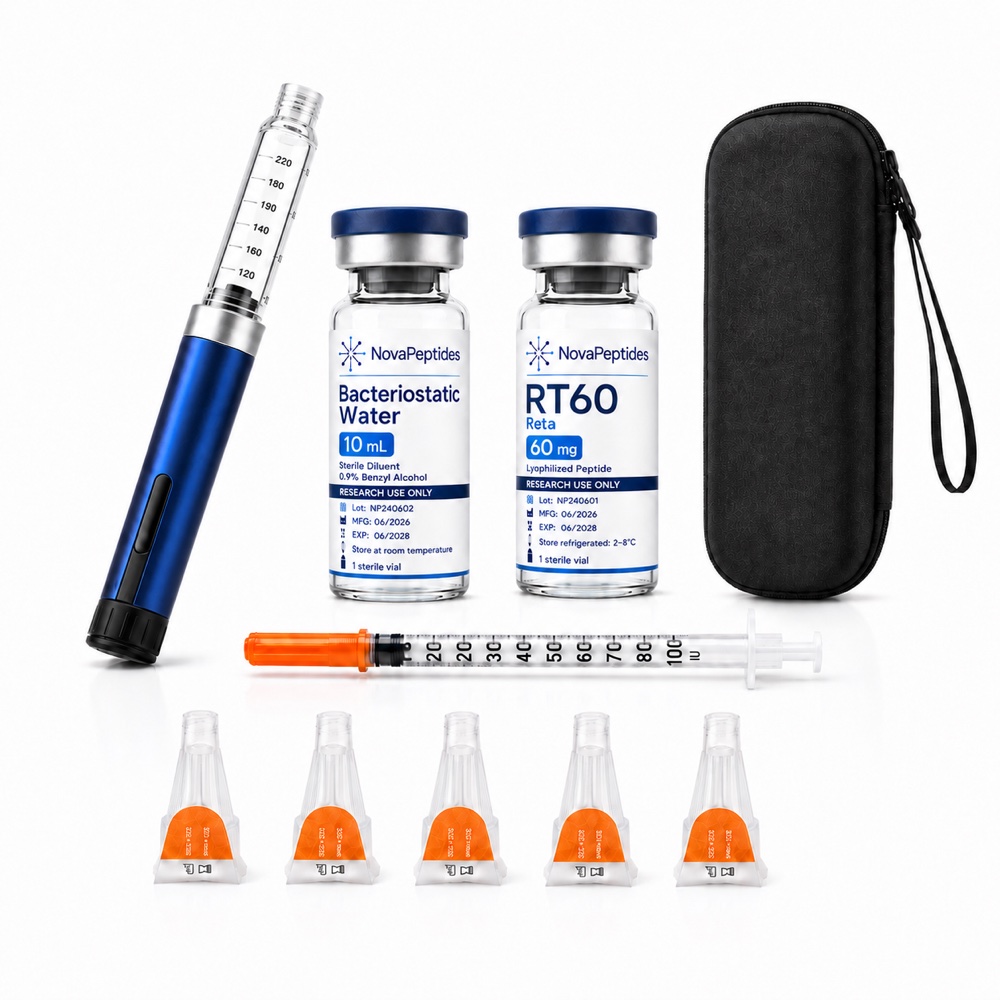
RT60 research kit
Contains Retatrutide, supplied as a complete, ready-to-assemble research kit. Research use only.
Enquire about RetatrutideNew to reconstitution? Our interactive pen and dosing guide shows how clicks convert to milligrams on a U-100 pen, with a switch for 2mL or 3mL of bacteriostatic water. It is provided for research reference only and is not a recommendation for human use. The dose you target is a decision for a qualified professional, not advice from us.
Frequently asked questions
What is retatrutide in simple terms?+
Retatrutide (LY3437943, also called the Triple G peptide, and supplied here in the RT60 research kit) is a synthetic peptide that activates three metabolic receptors at once: GLP-1, GIP and glucagon. It is studied in clinical trials for body weight reduction and metabolic outcomes. It is an investigational research compound, not an approved medicine, and is supplied for research use only.
What is the half-life of retatrutide?+
Retatrutide is designed as a long-acting peptide. Its albumin-binding fatty acid side chain slows clearance and extends how long it stays active in the body, which in research settings is consistent with a dosing interval measured in days rather than hours. Exact half-life figures vary with study conditions, so we point researchers to the published trial literature rather than quoting a single number out of context.
Does retatrutide build or preserve lean muscle?+
No, and it should not be framed that way. Retatrutide is researched for fat loss and metabolic outcomes, not muscle gain. As with other compounds that drive substantial weight reduction, a portion of the weight lost in studies can include lean mass. It is studied as an appetite and metabolic research compound, not a muscle-building one.
How is retatrutide different from tirzepatide?+
The core difference is receptor count. Tirzepatide is a dual agonist (GLP-1 and GIP). Retatrutide is a triple agonist, adding the glucagon receptor, which is researched for its role in energy expenditure. Both are long-acting peptides studied for weight and metabolic outcomes, but tirzepatide has a longer published research history while retatrutide is newer and still earlier in its trials.
Is retatrutide legal in Australia?+
Retatrutide is an investigational compound. It is not approved by the TGA for human use and is not registered as a medicine in Australia. At NovaPeptides it is supplied strictly for research and educational use only, not for human consumption. Anyone interested in approved options for personal health should speak with a qualified Australian healthcare professional.
How should retatrutide be stored and reconstituted?+
It ships as a lyophilised powder, which should be kept cold and out of light following standard peptide handling practice. When prepared for research use, it is reconstituted with a sterile diluent such as bacteriostatic water, swirled rather than shaken, then refrigerated with minimal freeze-thaw cycling. For reconstitution volume and pen mechanics, use the interactive pen guide. Any dose target is a decision for a qualified professional.
How do I know the retatrutide is genuine and pure?+
Every batch is independently tested by Janoshik, with a Certificate of Analysis available on request. Rather than relying on a number printed on a page, you can request the actual report and confirm the identity and purity figures against the lab's own verification records, because an independent certificate is something that can be checked rather than simply claimed.
Researching Retatrutide?
Message us and we will walk you through Retatrutide, the COA, reconstitution and how the kit goes together.
Chat with us on WhatsApp