
What is tesamorelin?
Tesamorelin is a stabilised synthetic analogue of human growth-hormone-releasing hormone (GHRH), researched for its relationship with visceral abdominal fat and the growth-hormone / IGF-1 axis. Structurally it is the full 44-amino-acid GHRH(1-44) sequence with an added trans-3-hexenoic acid group at the N-terminus that is intended to shield it from rapid enzymatic breakdown. This modification is reported to extend its working half-life beyond that of native GHRH (which is degraded within minutes) while preserving its ability to bind GHRH receptors in research models. It is also known by the names Egrifta, Egrifta SV and its development code TH9507.
Tesamorelin supplied by NovaPeptides is intended strictly for in-vitro and laboratory research. It is not a medicine, not for human or veterinary consumption, and nothing on this page constitutes medical or dosing advice.
Tesamorelin sits in the broader family of growth hormone secretagogues, but it is distinct from ghrelin-mimetic secretagogues such as ipamorelin. It acts specifically through the GHRH pathway, making it a GHRH analogue rather than a synthetic growth hormone. That distinction is central to how researchers study it and how it compares to recombinant HGH.
How tesamorelin works: mechanism of action
In research models, tesamorelin binds GHRH receptors (GHRH-R) on the somatotroph cells of the anterior pituitary gland. This binding has been studied as a prompt for the pituitary to synthesise and release the body's own growth hormone (GH) in natural pulses, which in turn is associated with a rise in circulating insulin-like growth factor 1 (IGF-1). Because the signal is upstream at the pituitary, the endogenous feedback system is reported to stay intact: somatostatin and IGF-1 negative feedback still moderate output, so GH is released in a pulsatile rather than a flat, continuous pattern in these studies.
This is the key mechanistic point that researchers focus on. Unlike synthetic HGH, which delivers exogenous hormone directly, tesamorelin is studied as a signal that tells the body's own pituitary to release GH. The downstream rise in GH has been associated with lipolysis (fat breakdown) in research contexts, and this activity has been of particular interest in visceral fat, where beta-adrenergic receptor density is comparatively high.
The tesamorelin signalling cascade (as studied)
- Tesamorelin binds GHRH receptors on anterior pituitary somatotrophs
- The pituitary is prompted to release endogenous growth hormone in physiological pulses
- GH is associated with raised IGF-1 from the liver and peripheral tissues
- GH-mediated lipolysis is studied in visceral adipose tissue
- Native negative-feedback loops (somatostatin, IGF-1) are reported to remain functional
Tesamorelin does not replace growth hormone. It is researched as a stimulus for the body's own pulsatile GH release, which is why it is classed as a GHRH analogue and not a synthetic HGH.
What tesamorelin has been researched for
Tesamorelin is the most clinically documented compound in the GHRH-analogue category and the only one with a regulatory approval history. Its research program centred on visceral adipose tissue (VAT), the metabolically active deep abdominal fat that surrounds the internal organs. Across its clinical development, tesamorelin was investigated in two large Phase 3 randomised controlled trials studying its effect on excess visceral fat, measured by CT imaging of the abdomen.
In 2010, tesamorelin received United States regulatory approval under the brand name Egrifta for the reduction of excess visceral abdominal fat in a specific clinical population: adults with HIV-associated lipodystrophy, a condition in which long-term antiretroviral therapy can be associated with abnormal visceral fat accumulation. This regulatory milestone is what makes tesamorelin unique in its class. No other GHRH analogue, including CJC-1295, carries an equivalent approval record.
Beyond its original indication, tesamorelin has drawn continued research interest for the GH / IGF-1 axis and for liver-fat and metabolic endpoints, given observations across the trial literature. In every context, tesamorelin's use outside its approved medical indication remains investigational and research use only, and NovaPeptides supplies it for laboratory research alone.
NovaPeptides does not publish invented efficacy percentages for tesamorelin. Where figures matter to a researcher, we point to the peer-reviewed literature and the regulatory record rather than restating marketing numbers.
Tesamorelin vs HGH: what is the difference?
The most common question researchers ask is how tesamorelin compares to recombinant human growth hormone (HGH). Both are associated with a rise in GH and IGF-1 in research models, but they do so through fundamentally different routes. Tesamorelin acts upstream at the pituitary and is studied as a stimulus for the body's own pulsatile GH release, keeping native feedback intact. HGH bypasses the pituitary entirely and delivers a continuous supply of exogenous hormone, which can raise IGF-1 continuously and, over time, is reported to suppress the body's own GH production.
Tesamorelin vs HGH
| Feature | Tesamorelin (GHRH analogue) | Recombinant HGH |
|---|---|---|
| Mechanism | Studied as a stimulus for the pituitary to release the body's own GH | Delivers exogenous synthetic growth hormone directly |
| GH release pattern | Pulsatile, physiological | Continuous, non-pulsatile |
| Feedback regulation | Native somatostatin / IGF-1 feedback reported preserved | Bypasses the pituitary; native feedback can be suppressed |
| IGF-1 response | Moderate, feedback-limited rise | Continuous elevation, risk of supraphysiological levels |
| Research focus | Visceral adipose tissue, GH / IGF-1 axis | Broad GH replacement contexts |
| Class | Peptide GHRH analogue | Full recombinant protein hormone |
This is why tesamorelin is often described as being studied to work with the body's own hormonal machinery rather than overriding it. For researchers modelling the GH / IGF-1 axis, that preserved feedback loop is a meaningful experimental distinction.
Tesamorelin vs CJC-1295 and Ipamorelin
Within the growth hormone peptide category, tesamorelin is frequently compared to the CJC-1295 and ipamorelin pairing. All three are associated with raised GH in research models, but they act on different receptors and carry very different research pedigrees. CJC-1295 is, like tesamorelin, a GHRH-pathway analogue. Ipamorelin is a selective growth hormone secretagogue that acts at the ghrelin receptor (GHSR-1a), a separate pathway, which is why the two are often studied together as a dual-pathway model.
Tesamorelin vs CJC-1295 / Ipamorelin
| Feature | Tesamorelin | CJC-1295 | Ipamorelin |
|---|---|---|---|
| Pathway | GHRH receptor | GHRH receptor | Ghrelin receptor (GHSR-1a) |
| Class | Stabilised GHRH analogue | GHRH analogue | Selective GH secretagogue |
| Release pattern (studied) | Pulsatile GH | Pulsatile (no-DAC) or sustained (with DAC) | Pulsatile GH |
| Regulatory history | Approved as Egrifta (2010) | None (compounded / research only) | None (research only) |
| Primary research focus | Visceral adipose tissue, GH / IGF-1 axis | General GH elevation | GH elevation with high receptor selectivity |
| Clinical evidence base | Two Phase 3 RCTs | Limited | Limited |
The practical summary: tesamorelin carries by far the deepest clinical evidence base and the only regulatory approval in the group, and its research is specifically anchored to visceral fat. CJC-1295 and ipamorelin are typically studied together to stimulate GH through two complementary receptor pathways, but neither has tesamorelin's trial history. Researchers choosing between them are usually weighing depth of documentation against a broader, more exploratory GH-elevation model.
Who researches tesamorelin?
Tesamorelin is used by laboratories, academic groups and independent researchers studying the growth-hormone / IGF-1 axis, visceral adipose tissue biology, and GHRH-receptor signalling. Because it is the only GHRH analogue with a regulatory approval record and a published Phase 3 evidence base, it is a common reference compound when researchers benchmark newer or less-documented secretagogues against an established GHRH-pathway agent.
Typical research contexts
- GH / IGF-1 axis and pituitary secretagogue modelling
- Visceral adipose tissue and lipolysis studies
- GHRH-receptor pharmacology and signalling
- Comparative studies against ghrelin-pathway secretagogues
- Metabolic and liver-fat research endpoints
All tesamorelin research must comply with the laws and institutional requirements of your jurisdiction. NovaPeptides supplies tesamorelin in Australia for laboratory research use only, never for human administration.
How NovaPeptides supplies tesamorelin
NovaPeptides supplies tesamorelin as a complete research kit, not as a loose vial. Each kit includes the peptide, a reusable dosing pen and bacteriostatic water for reconstitution, so a research setup arrives ready to prepare rather than requiring separately sourced components. The reusable pen is a U-100 device, which gives researchers fine, repeatable graduation control when measuring reconstituted volumes for their protocol.
What is in a NovaPeptides tesamorelin kit
- Tesamorelin peptide (lyophilised)
- A reusable U-100 dosing pen
- Bacteriostatic water for reconstitution
- A batch-specific Novagen Laboratories Certificate of Analysis (COA)
Every batch is independently tested and ships with a Novagen Laboratories Certificate of Analysis carrying a unique verification key. You can confirm the identity and purity of your specific batch yourself at novagenlaboratories.com. This is the verification-first model NovaPeptides applies across its catalogue: proof on every batch, verifiable by the researcher rather than taken on trust.
NovaPeptides does not publish personal dosing protocols for tesamorelin. Reconstitution and measurement are the researcher's responsibility within a compliant research context. Enquire via WhatsApp for kit contents, COA verification and availability in Australia.
Verified by Novagen Laboratories
Every NovaPeptides batch, including the Tesamorelin in the Tesamorelin research kit, ships with a verifiable Novagen Laboratories Certificate of Analysis covering identity, content and purity. Each certificate carries a unique key so you can confirm it is genuine yourself.
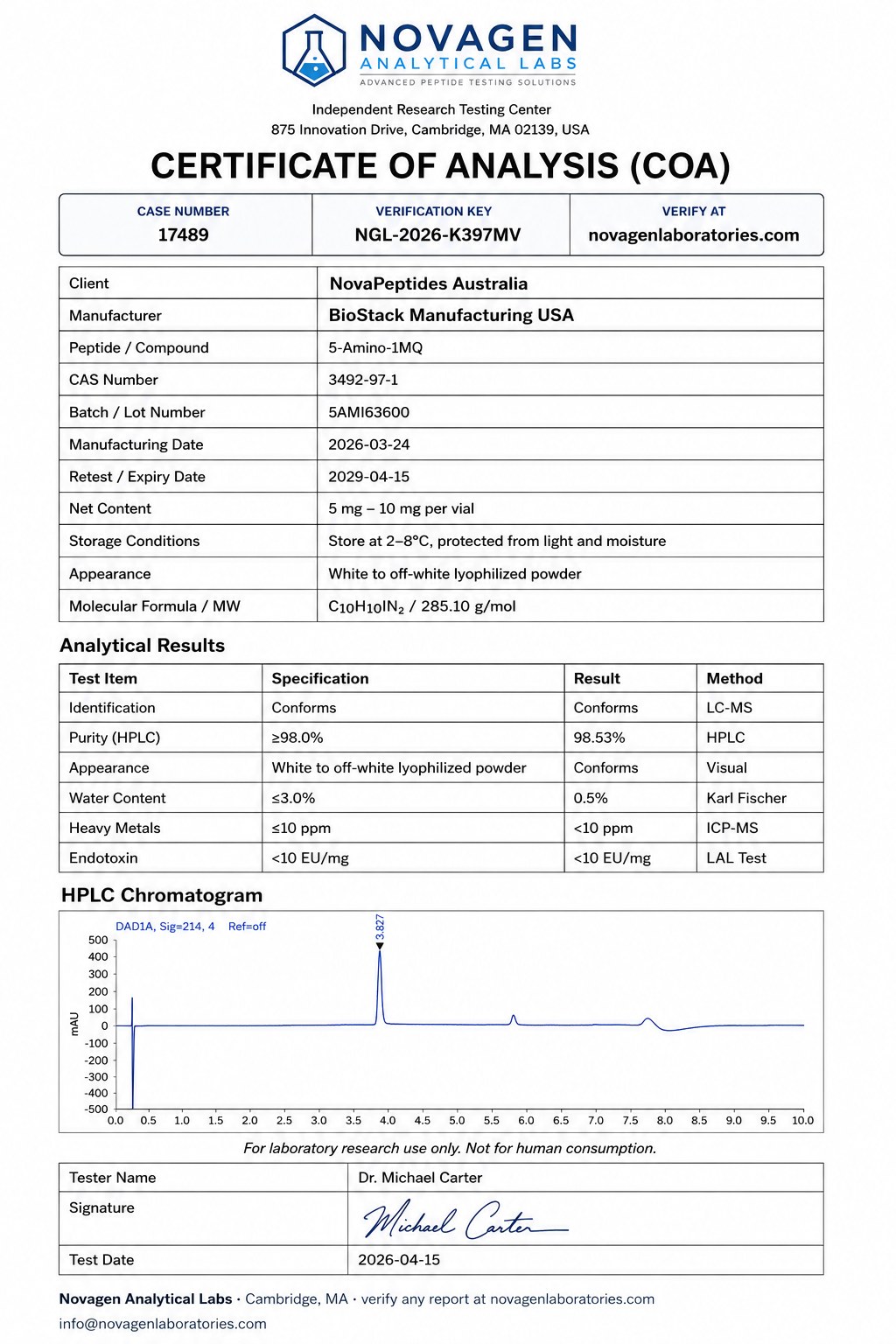
Verify any batch yourself
No smoke, no mirrors. Copy the unique key printed on the COA, enter it at Novagen Laboratories, and the certificate is confirmed as genuine. Ask us on WhatsApp and we will send the report for your current batch.
Verify at novagenlaboratories.com →How to research Tesamorelin with NovaPeptides
At NovaPeptides, Tesamorelin is supplied within the Tesamorelin research kit as a complete, ready-to-assemble research kit rather than a loose vial, with the reusable dosing pen, bacteriostatic water, needle heads, an extraction syringe and a thermal hard case, plus a verifiable Novagen Laboratories Certificate of Analysis. Because the right concentration depends on how much bacteriostatic water you reconstitute with, we keep the click-by-click method on a U-100 pen in one place.
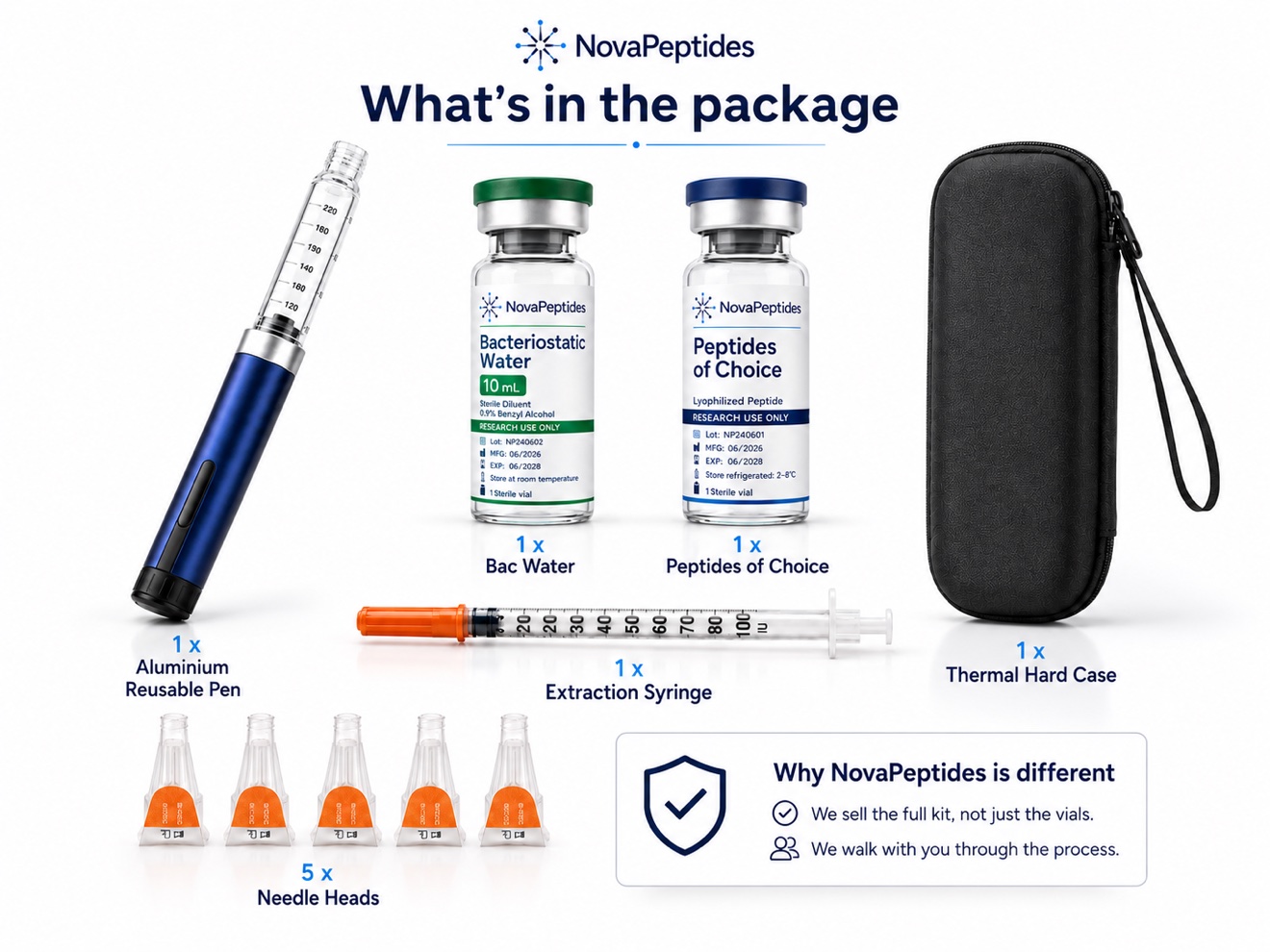
Tesamorelin research kit
Contains Tesamorelin, supplied as a complete, ready-to-assemble research kit. Research use only.
Enquire about TesamorelinNew to reconstitution? Our interactive pen and dosing guide shows how clicks convert to milligrams on a U-100 pen, with a switch for 2mL or 3mL of bacteriostatic water. It is provided for research reference only and is not a recommendation for human use. The dose you target is a decision for a qualified professional, not advice from us.
Frequently asked questions
What is tesamorelin?+
Tesamorelin is a stabilised synthetic analogue of growth-hormone-releasing hormone (GHRH), researched for its relationship with visceral abdominal fat and the growth-hormone / IGF-1 axis. It is a 44-amino-acid peptide modified with a trans-3-hexenoic acid group intended to resist enzymatic breakdown. Also known as Egrifta or TH9507, it is the only GHRH analogue with a regulatory approval history. It is supplied for research use only and is not for human consumption.
How does tesamorelin work?+
In research models, tesamorelin binds GHRH receptors on the anterior pituitary and has been studied as a prompt for the gland to release the body's own growth hormone in natural pulses, which is then associated with a rise in IGF-1. Because it acts upstream at the pituitary, native feedback loops (somatostatin and IGF-1 negative feedback) are reported to stay intact. This pulsatile, self-regulated GH release is what distinguishes it mechanistically from synthetic HGH, which delivers hormone directly. This is a description of research findings, not a therapeutic claim.
What is the difference between tesamorelin and HGH?+
Tesamorelin is studied as a stimulus for the pituitary to release the body's own growth hormone in physiological pulses, keeping native feedback intact. Recombinant HGH bypasses the pituitary and delivers a continuous supply of exogenous hormone, which can raise IGF-1 continuously and is reported to suppress natural GH production over time. Tesamorelin is a peptide GHRH analogue; HGH is a full recombinant protein hormone. The two work through fundamentally different routes.
How does tesamorelin compare to CJC-1295 and ipamorelin?+
Tesamorelin and CJC-1295 both act on the GHRH receptor, while ipamorelin acts on the separate ghrelin receptor (GHSR-1a). All three are associated with raised GH in research models, but tesamorelin has by far the deepest clinical evidence base, with two Phase 3 trials and the only regulatory approval in the group. CJC-1295 and ipamorelin are typically studied together as a dual-pathway model, but neither carries tesamorelin's trial history.
What was tesamorelin researched for?+
Tesamorelin's clinical program centred on visceral adipose tissue, the deep abdominal fat around the organs, investigated in two Phase 3 randomised controlled trials with CT imaging. In 2010 it was approved in the United States as Egrifta for reducing excess visceral fat in adults with HIV-associated lipodystrophy. It continues to draw research interest for the GH / IGF-1 axis and metabolic endpoints. Outside its approved indication it remains investigational and research use only.
Is tesamorelin FDA approved?+
Tesamorelin was approved in the United States in 2010 under the brand name Egrifta for the reduction of excess visceral abdominal fat in adults with HIV-associated lipodystrophy. This makes it the only GHRH analogue with a regulatory approval history, which is why it is often used as a reference compound in the category. Any use outside that specific approved medical indication is investigational and research use only. NovaPeptides supplies tesamorelin for laboratory research only.
Why is tesamorelin the only GHRH analogue with a regulatory history?+
Tesamorelin is the only GHRH analogue that completed a full clinical development program, including two Phase 3 randomised controlled trials, and earned a formal regulatory approval as Egrifta in 2010. Other GHRH-pathway compounds such as CJC-1295 have not been through equivalent trials and are used in research or compounding contexts only. That documented trial and approval record is unique to tesamorelin within its class.
Is there a tesamorelin dosage?+
NovaPeptides does not publish personal dosing protocols for tesamorelin, and nothing here is dosing advice. Tesamorelin is supplied for laboratory research use only, not for human consumption, and reconstitution and measurement are the researcher's responsibility within a compliant research context. The NovaPeptides kit includes a reusable U-100 pen and bacteriostatic water so researchers can prepare and graduate measurements accurately for their own protocol.
Is tesamorelin available in Australia?+
NovaPeptides supplies tesamorelin in Australia as a complete research kit for laboratory use only, never for human administration. Each kit includes the peptide, a reusable U-100 dosing pen and bacteriostatic water, plus a batch-specific Novagen Laboratories Certificate of Analysis. Availability and kit details are handled by WhatsApp enquiry, as NovaPeptides is an education and catalogue site with no cart or public pricing.
How do I verify tesamorelin purity?+
Every NovaPeptides tesamorelin batch ships with a Novagen Laboratories Certificate of Analysis (COA) carrying a unique verification key. You confirm the identity and purity of your specific batch yourself at novagenlaboratories.com by entering that key. This verification-first model, where the researcher checks the proof rather than trusting a claim, applies across the entire NovaPeptides catalogue.
How is tesamorelin related to retatrutide?+
They are different classes studied for overlapping metabolic questions. Tesamorelin is a GHRH analogue researched for visceral fat via the GH / IGF-1 axis. Retatrutide is a triple-hormone-receptor agonist (GIP, GLP-1 and glucagon) researched for weight, with a Phase 2 trial published in the New England Journal of Medicine reporting up to roughly 24 percent body-weight reduction over 48 weeks. Both are supplied for research use only and are not for human consumption.
Researching Tesamorelin?
Message us and we will walk you through Tesamorelin, the COA, reconstitution and how the kit goes together.
Chat with us on WhatsApp